
Location

Changping District, Beijing, China
Reasons to visit
World Cultural Heritage; The most essential part of the China Great Wall
Opening Hours
- 8:00-17:00 from April to October
- 8:30-16:00 from November to next March
Juyongguan Great Wall had already ranked as one of the eight splendid sceneries in Beijing 800 years ago. In Chinese, "guan" means mountain pass, so Juyongguan Section is a part lying through mountains as a wall to prevent the enemies. It is 60 km from the downtown of Beijing and 20 km from Badaling Great Wall. Enlisted in the World Heritage Directory in 1987, Juyongguan Great Wall is a national cultural protection unit. And Juyongguan Pass is one of the three greatest passes of the Great Wall of China. The other two are Jiayuguan Pass and Shanhaiguan Pass.
In the history, Juyongguan Great Wall is a very important strategic place connecting the inner land and the area near the northern border of China. It is also a defensive place for the ancient Beijing City. In the tourism field, Juyongguan Great Wall is a part for adventurers as well as photographers to appreciate the most original atmosphere to the ancient battle. 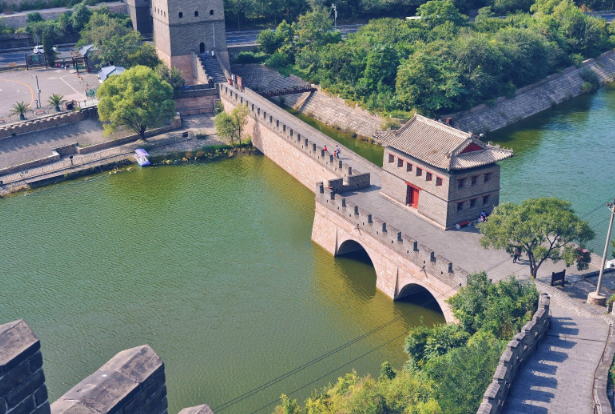
Architectural features
The common view of Juyongguan Great Wall is the majestic views of passes, rolling crenels and exquisite stone carving on 'Cloud Platform'.
The main architectural features of the Great Wall include:
► It is a circumferentially closed-shaped building. Surrounded by mountains, the Pass is roughly circular with a perimeter of about 4,142 meters (about 4,530 yards).
► This pass has great changes on width and height. The widest sited of it is 16.7 meters; the narrowest site 1.2 m. It has low walls inside, while high walls outside. The outside wall is called forts walls. The walls can effectively defense the enemies.
As all known, every part of the Great Wall is famous for the dangerous geography, Juyongguan section is also included. It had been called in different names in different dynasties. And the present name Juyonguan was applied in the Qin Dynasty when Emperor Qinshihuang ordered the building of the Great Wall. Juyongguan Pass has two passes, one at the south and one at the north. The south one is called "Nan Pass" and the north one is called "Badaling". This pass was connected to the Great Wall in the Southern and Northern Dynasties. 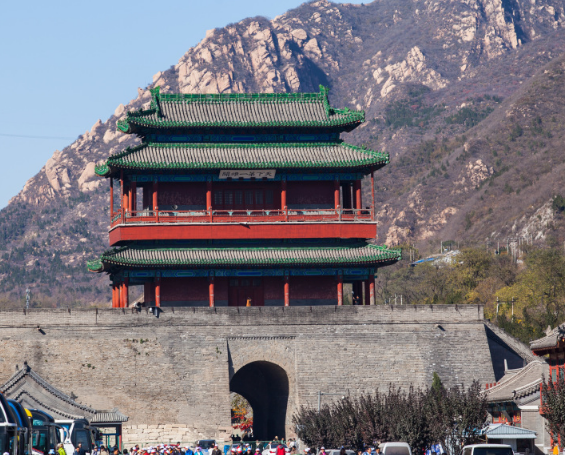
In the middle of Juyongguan Pass lies a high platform called 'Cloud Platform', which is made of white marble. In the Yuan Dynasty, three stone towers were built on the platform. At the end of Yuan Dynasty, they were burnt down. Inside the platform is an arched doorway. On the walls of the doorway, the statues of four heavenly gods (four gods in Chinese legend who guard the country in four directions) and sutra scriptures are carved. Many animal images were carved in the arched hole and the arched door. On the walls of both sides of the door, the statues of gods and scriptures are carved. There were three white towers on the platform in the past (this is how it got the name of "Crossing Street Tower") and were destroyed in the transitional period between the Yuan Dynasty and the Ming Dynasty. Later a Tai'an Temple was built on the platform but was later destroyed in the Qing Dynasty. The walls also feature inscriptions of Buddhist texts written in six languages and six scripts:
Recommended Touring Routes
1. East Route (Easy & Family-Friendly)
Route: North Gate Tower → Watchtowers No. 1–6 → East Arrow Tower
Duration: Around 2 hours
Highlights: This section features relatively gentle slopes, making it suitable for families, seniors, or travelers with limited stamina. Along the way, visitors can admire the scenic view of the “Flower Train”—a train running through blooming fields at the foot of the wall during spring.
2. West Route (Moderate Difficulty)
Route: South Gate Tower → Western Slope → Watchtowers No. 12–14
Duration: About 2.5 hours
Highlights: This route is steeper but offers breathtaking panoramic views of the entire fortress and the surrounding mountains. It’s ideal for hikers who enjoy a challenge and wish to experience the grandeur of the Wall’s defenses.
3. Circular Route (For Experienced Hikers)
Route: Ascend via the West Route to Watchtower No. 12 → Cross over to the East Route → Return to the starting point
Duration: 4–6 hours
Highlights: This full loop allows visitors to appreciate the entire Juyongguan Pass, including its fortifications, Cloud Platform, and mountain scenery. However, it is physically demanding, so good preparation and adequate rest are essential.
Main Attractions
The Pass City and Barbican Towers
The existing Juyongguan Fortress, built during the Ming Dynasty, forms a closed circular defensive system stretching about 4,167 meters in circumference. It consists of the East and West Wall Sections, South and North Gate Towers, the river-crossing wall, and the sluice gate. Both the southern and northern entrances have barbican walls, creating a double-layered defense system. The gates are positioned sideways, allowing defenders to attack invading enemies from multiple angles.
The Cloud Platform (Yuntai)
Located at the heart of the pass, the Cloud Platform is the most precious relic of Juyongguan. Built of white marble in the Yuan Dynasty, it once supported three pagodas, which were destroyed in the late Yuan and early Ming periods. The remaining base, however, is a masterpiece of ancient Chinese stone carving.
The arched passageway at its center was designed for people, horses, and carts to pass through. Inside, the walls and ceilings are exquisitely engraved with Buddhist statues and inscriptions of the Diamond Sutra written in six scripts and languages—Sanskrit, Tibetan, Phags-pa, Uyghur, Tangut, and Chinese. The artistic carvings, detailed lotus patterns, and water-draining dragon heads showcase the high level of Yuan Dynasty craftsmanship and Buddhist influence.
Watchtowers and Beacon Towers
Along the ridges surrounding Juyongguan stand numerous watchtowers and beacon towers. The hollow watchtowers are built in different structural styles, including brick structures with two, three, or five arches, and brick-wood hybrids featuring hip roofs and multi-eaved corners. These towers served as lookout posts, storerooms, and living quarters for soldiers. The beacon towers played an essential role in ancient military communication, relaying smoke signals and flames to warn of enemy movements.
“Green Layers of Juyong” (Juyong Diecui)
Flanking both sides of Juyongguan are towering green mountains. Between them lies a long, winding valley known as “Guangu,” stretching for 18 kilometers. Crystal-clear streams flow through the valley, surrounded by lush forests, vibrant flowers, and singing birds. This enchanting landscape, especially during spring and autumn, was historically praised as one of the “Eight Great Sights of Yanjing” for its poetic beauty.
Travel Tips
Best Visiting Time: Spring and autumn are ideal, when peach blossoms or red maple leaves adorn the mountains.
Duration: Plan at least half a day; morning visits are recommended to avoid midday heat.
Footwear: Wear comfortable shoes with good grip—some sections are steep with uneven stone steps.
Safety: Be cautious when climbing; follow the signs and staff instructions, as some areas may be under maintenance.
Facilities: There are convenience stores and restrooms along the route, but they are scattered, so plan your breaks accordingly.
How to Get o Juyongguan Pass
• Take the Subway Line 13 and get off at Longze Station in Changping District, take the shuttle bus No.68 and you will get there
• Take the Badaling Expressway and take the Juyongguan Pass Exit.
• Take Buses No.1,2, 3, 4, 5, 919 and get off at Juyongguang Pass Statio
Note: Peach blossoms in spring and maple leaves in autumn make the Juyongguan Great Wall more charming. Visiting to Juyongguang Great Wall can give visitors a wonderful experience, different from other sections of the Great Wall.